Regional Inequalities: Empowering Communities for Change
Regional Inequalities: Empowering Communities for Change
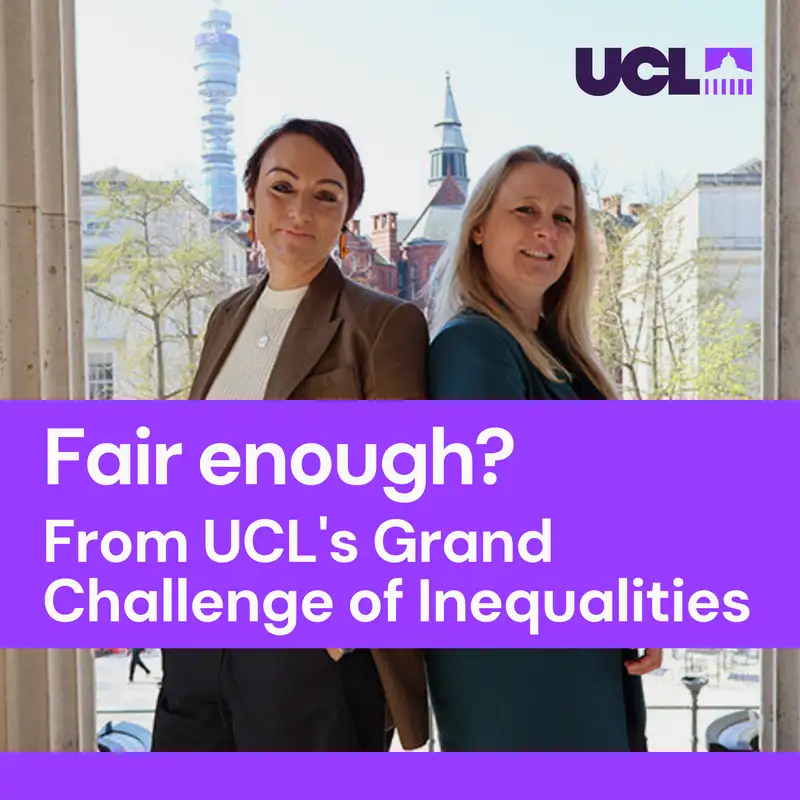
Lauren Andreas: Hello and welcome to Fair Enough, the new podcast from UCL Grand Challenge of Inequalities. It explores existing and emerging innovative solutions for delivering everyday justice. I'm Lauren Andras.
Victoria Austin: And I'm Victoria Austin. In this series we'll bring together visionary leaders from across disciplines and sectors to ask one simple question. When it comes to tackling inequalities, are we doing enough?
Lauren Andreas: So whether you work in industry, government policy or research, or you simply care about what a fairer future could look like, this podcast is for you. So let's get started. In today's episode we're going to be exploring regional inequity and what we can do about it. We are joined by two brilliant guests that Victoria is going to present.
Victoria Austin: Thank you, Lauren. So today welcome Saffron Woodcraft, Professorial Research Fellow of Collaborative social science at UCL's Institute for Global Prosperity where she's also the director of UCL's Citizen Science Academy. Saffron's research focuses on understanding the lived experience of communities, shared prosperity and inequality in urban, neighbourhoods. She works collaboratively with citizen scientists, community organisations, government policymakers and business decision makers to bring local understandings of prosperity into planning and decision making processes. We're also delighted to be joined today by Professor Graham Thrower head of the Institute for Economic and Social Inclusion at the University of Sunderland. Graham leads interdisciplinary work that informs joined up insights and research into areas such as inclusive learning, inclusive living, inclusive work and the relationship between these and the health outcomes of excluded communities. Both of you, thank you so much for joining us today.
Saffron Woodcraft: Thank you very much.
Graham Thrower: Thanks.
Lauren Andreas: It's brilliant to have you. And we're going to kick off the discussion with our first question where we would really want to hear your thoughts about what are the elements of regional inequality that feel most pressing but also problematic at the current time? Saffron, I'm sure you have a lot to say and similigram but Saffron, do you want to give us your thoughts?
Saffron Woodcraft: Yeah, thank you very much. So what I've been thinking a lot about recently is the relationship between inequality and insecurity and how that plays out in people's everyday lives. there's been a lot of discussion about inequalities as a, as a multi system risk. So quite a lot is known about how inequalities impact on people's health in the long term or economic opportunity, for example. But what I've been thinking about is where insecurity and inequality have a relationship kind of in this picture and that's because insecurity has become a defining feature of everyday life, in the 21st century. Zero hours contract, insecure work, insecure income. And then through the various crises over the last decade, insecure food and energy as well. Now we often talk about the cost of living crisis and some of these insecurities as a crisis, but I think these are chronic problems. and I think shifting that language from crisis, chronic problems is really important. So yes, insecurities are acute, but if we think about them as ah, ah, long term system related challenges then we can start a different conversation about how we tackle them. and policy responses shift then from kind of mitigating the effects of crisis to trying to think about what some of the systemic problems are. so that hasn't directly answered your question about kind of regional imbalances, but I think that intersection of inequalities and insecurities is playing out in different ways in different places.
Lauren Andreas: This is fascinating and I really like your point around cronic and the long term because obviously in our current context this clashes a lot with the short term political time frame. I mean Graham, I'm sure you have so much more to add to this discussion as well.
Graham Thrower: Yeah, thanks. And thanks also for having me on the podcast. Yeah, I think my biggest concern is that we are all continuing to look away from the problem. people often use the phrase hard to reach about some of the communities that we work with. A, colleague of mine said also, easy to ignore. And I think it's that ignoring is an issue because the sort of
00:05:00
Graham Thrower: problems that we're going to be talking about are not unique to the last 10 years. in the Northeast, it's really the last 60 years, or at least 50. and now we have a situation where the electoral mandate of the most recent government notionally would suggest that we are in a phase where we could be socially progressive. But it doesn't really feel that way. I think for all of us working in this space it feels that conventional economic measures continue to hold sway. So we're talking about economic growth rather than inclusive growth. We're talking about inward investment, we're talking about sectoral growth, but with a real focus on the shiny sectors, AI tech, advanced manufacturing, clean energy, rather than perhaps a due recognition of the huge role that's played by the foundational economy. For example, we're talking about productivity growth but we're not really focusing on how that's accompanied by rising real term wages. We're talking about job growth, although that job distribution is often exacerbating existing inequalities and widening them. And the same communities that have been left behind over recent decades remain outside looking in or probably actually because they feel isolated, more accurately inside looking out. So I think that's a real issue
Lauren Andreas: and it is a real issue, especially noting then the political implications because we know as well how much this is linked to the rise of populism and all the dangers associated to it.
Victoria Austin: You started to touch there Graham, a little bit on some of the hypotheses or assumptions rather that we are making collectively in the mainstream about some of these problems. And I'd like to sort of start there really. And Saffron's already begun to answer this question, but I'll maybe come to you Graham first because you, you kind of started what would we need to do differently? Which assumptions would we need to unpick? What would the revolutionary approach to change be if we were willing to think outside of the, about addressing some of these issues about inequalities?
Graham Thrower: well I think maybe I'll touch on three areas. Data technology generally and then perhaps community, in data. I think we see in our day to day interactions that there are huge volumes of data at a, ah, local level, hyper, local organisations, third sector bodies have enormous volumes of really granular information and in some cases are sharing it with each other. However, they are kind of to a degree outside the trusted tent of public sector data flows. So when it comes in to that information, getting into the kind of public sector pathways and decision making processes, it's often not as efficient as it might be. On the other side, the sort of data that does flow through official channels that contribute to things like indices of multiple deprivation and Idaki for instance, are kind of a cocktail of data sets, some of which, their components are very dated. we're making policy against the backdrop of partial, aggregated and sometimes time compromised data. So I think there's a real opportunity there to understand better how we can capture more of the current data around these communities of real need. I think when it comes to technology the challenge is to ensure that it doesn't have an adverse distributional impact on those who are already marginalised and excluded. so this is a lot more by the way than just digital inclusion. This is about reflecting tech literacy and pathways to employment. For example, it's about ensuring that the algorithms and AI already informing public service delivery recognise and incorporate models of individual and community characteristics that look and feel like those living in marginalised communities. I think AI offers an enormous opportunity for us to better deal with and understand the complexities of real life and the kind of multiple factors that are pressuring people in these kind of disadvantaged communities that Safron touched on. But we need to make sure that it's applied in a way that alongside policy, funding and real world delivery, can make a real change in our communities. And on that last point, community, I mean, I think probably the way we all work on this, podcast, it all starts in the streets, neighbourhoods and communities, citizen researchers, experts by lived experience, working with frontline trusted organisations, how we can use that to capture replicable, effective interventions and understand how they need to evolve for different contexts. It's a challenge, but it's much better to have that challenge than a more top down approach, I would argue.
00:10:00
Graham Thrower: and one final point on these communities, which is we really need to acknowledge that in these communities there are many people who feel they have consultation fatigue, many people who feel that they've had a number of what I would call bungee interventions for decades. Researchers have been paid, delivery organisations have been paid, local authorities have been paid, but too often the people on the ground, not only have they not been paid for their time, but worse, they see little or, no change to their lives. So we have interventions and schemes that last for the duration of the funding and are gone. Learning's not captured, people are left high and dry and then the cycle starts again. So for whose benefit do we wonder really, that people feel despair or cynical or in some cases, as Lauren touched on, are, angry?
Victoria Austin: It's a good point. Safon, what do you see for the next five years? Is there any hope?
Saffron Woodcraft: I hope so, yeah. I do have some hope because you have to maintain some hope. Right.
Victoria Austin: It's a daily practise.
Saffron Woodcraft: It's a daily practise, exactly. So, you know, going back to your question about what are the fundamental shifts that we need to see, I think for me it's really important that policymakers, politicians, people who are making decisions about place, shift towards seeing spending on people and places as an investment in the economy and in society instead of just a kind of a cost to taxpayers. M so that shift to thinking about, public services as a really essential piece of social, social infrastructure that is as important as roads, bridges, other bits of the kind of physical infrastructure is really important. And the British Academy has done some interesting work on this recently, making a similar argument. So there is a growing kind of conversation about the need for this shift, what we need to do is work, work at the, the regional level, at the city level, at the kind of place level to understand how you actually put that into practise. So how do you operationalize, the concept of a social economy? And I think part of that again, goes back to changing the kind of the terms and the concepts that we use. so Graham mentioned that the idea of inclusive growth is very popular at the moment. You hear a lot of, people talking about the need for inclusive growth. Obviously, central government has a, Has a, has growth, is the economic growth is the barrier to mission. But I think there is a difference between thinking about inclusive growth, which is about growth first, and then redistribution, later, or inclusive economies, which kind of shifts the focus from thinking about what do you need in an economy in terms of services and people and capitals to make it work. and how are you thinking about inclusion from the beginning as opposed to kind of the growth first, redistribution later. So for me, that's a really important shift. And I think, you know, politically we do have a moment. so, you know, we have regional mayors receiving new powers, we've got local growth plans, we've got local industrial strategy. So that there is a moment, it's absolutely not guaranteed, that that will translate into, improved outcomes. But at least, to your question about hope, there is a moment when these things could change. And I saw Andy Burnham last week talking about, 10 years of devolution in Manchester, and Manchester risen as an approach to thinking about, thinking about growth and what Grace did to do for the city. And that focus on public services, providing the infrastructure that then enable people to participate in the economy, care for their families, contribute, to civil society, be part of a community, was a really important part of what, you know, what he had to say. So I think there's possibility, but there's definitely a disconnect between government missions, and kind of government policy which tends to still focus on a single goal or a kind of a single policy area. And, some of the really good stuff that is happening at a regional level, which takes a more holistic, holistic approach.
Victoria Austin: And I want to come back to the idea of what inclusive economies might really be. But first of all, Graham, do you think the Northeast needs Manchesterism?
Graham Thrower: I certainly think the Safron's right to say that the devolution agenda, offers a real moment of opportunity. Because I think some of the, opportunities can definitely be generated regionally
00:15:00
Graham Thrower: and within Region and, you know, taking local learning, you know, more efficient use of local resources. But actually, one of the things that Manchester has proved, really from the time of the Manchester Independent Economic Review, which now seems like a very long time ago, is that actually, if you have more control over the budgetary envelopes, you can start to craft more bespoke solutions and a m. More bespoke allocation of resources to those areas of your regional economy and those themes that are most pressing for your population in a way that's very difficult if you have none of those kind of financial levers. So, undeniably, I think devo, or devo Max, which obviously is what people are looking to, offers a, real opportunity and I wonder whether there's an appetite and a bravery within region to then cascade that devo movement down further from the regional bodies like the mayoral combined authorities, to local authorities and then even to kind of community type, resources. I think the point that Safbar made around social infrastructure is critical. The social connective glue, the social infrastructure is what has really been eroded, over the years, I think, in many of our most disadvantaged communities. It's not a uniquely uk, facet. I did some work in the heartlands of Ireland. The same things happened there. The infrastructure, social infrastructure, been eroded over time. So I think there is a pressing need to invest in it. But actually the dimensioning of where that should be invested and how much is revenue, how much is capital, how much is allocated to this programme or that programme, I would argue, can best be assessed by those closest to the issue. So we have to trust in this devolution moment. It's not just from national to regional, it's then regional and further down. And that is, I think maybe a challenge for our political leaders.
Victoria Austin: So maybe it's not so much Manchesterism, but New Yorkism in terms of the amount of power the mayor has to introduce, transport infrastructure, housing changes and filtering that right down.
Graham Thrower: Yeah, because we're seeing it, aren't we? We're seeing local authorities, for instance, cities all over the country taking back control of elements of their transport infrastructure, buses notably, but also bringing back into their control social housing stock and things like that. So these things are starting to happen, but they all require the policy levers, the ability to actually do that in law, and then the financial resources to be able to take those sort of responsibilities on board.
Lauren Andreas: Graham I mean, you mentioned trust and I wonder if we can pick up a little bit on this, because I think we mention hope a lot and, from My perspective, hope and trust are linked and it links to all the elements we've been just discussing now. I mean knowledge, learning, power relationship, the importance of place based approaches. And for me here trust is crucial because we are in this phase of transition where we need to restore trust in our local democracies. But also it's about trust in what if everything we do, it's trust in the data that is used, it goes back to knowledge sharing, it's trust from between the local communities and the political leaders and vice versa. And I think really trust and the opportunity to restore trust in a very holistic approach of what trusted is really crucial and I think resonates a lot with what you, Saffron and Graham have been saying and it is at the core of hope.
Graham Thrower: Yeah, I mean I would agree with that. But trust always has to be earned, doesn't it? And it's absolutely. So in that sense trust relates to delivery. I would say, you know, if you as an individual or as a community open yourselves to people who are wanting to try and understand the challenges you're facing and those people then take those storeys away with a kind of mandate to try and bring some kind of intervention back that will improve your lives and improve the opportunities for you and your children. if they come back and do that they earn trust and if that trust is delivered via democratic means then great. but democracy in and of itself doesn't have an automatic right to trust.
Lauren Andreas: Exactly.
Graham Thrower: Organisations and people. I think where we've had a problem is that you know, I think a
00:20:00
Graham Thrower: lot of times these communities have opened themselves up to people but sometimes that hasn't been accompanied by any noticeable improvement in their situation and therefore they feel ignored and that then has a whole load of knock on issues that you've kind of touched on. So trust. Absolutely. And there are many trusted organisations and I think both UCL and Sunderland has a lot of colleagues who are working in over really long term relationships with some of these communities. but you know we have to deliver, we have to deliver some kind of positive change and actually despite what I said earlier, I do have a lot of hope but I think it's really important that we recognise that what we need is a combination of better ways of working at a local and regional level coupled with perhaps more devolution and trust being bestowed from national government to the regional and the local. and we can't do it without both I think.
Victoria Austin: Saffron, can I come to you? Because I think one of the Ways that we build trust in communities is by working with communities and empowering communities to lead some of these debates which is exactly what your work is. So I wonder if you have anything to add.
Saffron Woodcraft: Yeah, so several points that Graham may connect to the thinking behind the Citizen Science Academy. So I think the key point he was making about knowledge and knowledge needing to be not just situated in communities but produced by those communities, owned by those communities, advocated by them on their behalf is one of the kind of founding principles academy. So the idea behind that is that and I think this comes back to another point which is about the role that universities can play as anchor organisations in trying to hold the space to support communities, generate their own knowledge but to then also support decision makers in using it. That's something that we can do and you know we can do that because we're long term I hope you know organisations UCL celebrating its 200th anniversary but you know we're long term place based partners and in some ways can kind of mitigate some of the project, the narrow kind of short term project problems that Graham was talking about. So you know we don't just want to go into communities, collect data, finish our project, write a nice report, put it on the shelf. you know if universities are serious about long term partnership and commitments to place then we need to practise that. so the idea behind the Citizens Science Academy is that you know we work with communities and decision makers on kind of live research questions which are about face or about the lived experiences of particular groups and build everyone's capacity together to understand both the challenge and to bring a different kind of data into thinking about a policy solution or a service redesign, but also thinking then about how that knowledge feeds back into academic research. How does it then help us to redefine the questions that academic researchers are working on or how does that help us to then challenge conventional theory? So we were talking earlier about how do we challenge some of the conventional assumptions ah behind economic theory and policy and it helps us to kind of feed back into into that loop as well. A key part of that is about building the infrastructure, the knowledge infrastructure in those places. Otherwise we are just falling back into the project trap again. So we need to build the capacity of both citizen scientists by training and employing lots of citizen scientists but also the voluntary sector, the government decision makers, the public agencies and others to work with them. So those practises become embedded in decision making. So as Graham said, you know, these, different kinds of insights and different forms of knowledge need to be used on a day to day basis. It's not sufficient just to do a great risk research. and everyone say, well that was really insightful, thank you very much. you know, we don't have the ability to incorporate it into what we're doing on a day to day basis. and you know, it's that kind of work that we can do with the System Science Academy, with local authorities and others, helps them think about how they bring this way of working directly into their policy making processes. So, you know, I think that that role that the university, universities can play, going back to what Graham was saying about devolution
00:25:00
Saffron Woodcraft: is whether you think when we need to revive the double devolution language of 25 years years ago, you know, is that helpful or not?
Graham Thrower: But devolution is ultimately trust. I mean, I think one of the reasons why perhaps the Northeast was relatively speaking, slower to get devolved powers than somewhere like Manchester is Manchester did a fantastic job of portraying themselves as a safe pair of hands where everyone was pointing in the same direction. And rather kind of famously the Northeast for a long time wasn't really seen in that light. So if we're going to have double devolution, then we need to think really carefully about how we satisfy that trust, requirement at a local and hyperlocal level so that the likes of regional authorities are comfortable to be devolving, decision making, programme, design, financial resource, down to this kind of local level.
Victoria Austin: I mean, I think you're right. I think there's also something peculiar about Manchester. At that time I was working at the Regional Development Authority and I think there's something peculiar about the city's response to the attack and the fact that it chose to redouble its efforts to create an identity for itself, following the bomb that not only enabled physical redevelopment but also a kind of cultural redevelopment of Manchester as a space and a place which became desirable. And I feel like that kind of notion is also, I recognise it from a little bit, the London 2012 effect in East London. This idea of what we're for, what do we do around here, what is the thing that we're known for? And there's something about that kind of notion of, I guess what the government's now calling pride in place, but it's quite a loose association with the way I've just described it. And I think there's something about the way communities are able to participate in setting a vision for their own communities, our own communities, since we are all also in them, which we feel has the opportunity to be co designed and trusted. And I think that's why the point about engaging citizens in that process becomes so important. You can theorise it like Amartya Sen did, as participation being the means as well as the end, or you can just look outside the window and recognise that having people involved in the process around them builds trust, builds political willing, builds collectivism, et cetera.
Lauren Andreas: I mean, absolutely fascinating to hear you both talking about already what can be done really. interesting as well. Well, to hear and to come back to the example of Manchester, Manchesterism. I mean Andy Burham has been coming a lot already to UCL through the UCL Policy Lab. And Andy, if you're listening, we would love to have you on the podcast and to be able to discuss this with you much further. This is a call, but really I just want to build more on what Safra and Graham, you've been already identifying as solutions that are emerging and I'm just wondering if you would like just to identify one or two solutions which to your view could be scaled up.
Graham Thrower: Can I slightly twist your question?
Lauren Andreas: You can of course, because I feel
Graham Thrower: like I probably talked a fair bit about what can be done at a local, regional level and I mentioned earlier that I think there is another side to this and that's around national enablers. so alongside the kind of locally determined actions, I think some of the systemic issues where policymakers at a national level have a real role to play around obvious things like tax, take that, narrow wealth gaps and taxes, earned income less than unearned income, investment in early years, addressing some of the, perhaps perverse disincentives of the benefit system around apprenticeships, addressing some of the disincentives to work faced by people, for instance in supported accommodation when they try and join the labour market and then generally legislation around what we might term as exploitative working practises, zero hours contracts and these sort of factors that mean, we are seeing a rise in the working poor. You know a lot of people using food banks are in employment, they're not unemployed, many of them. And those are things where there are local organisations that we all work with who are dealing with the consequences of these issues. But ultimately I think solutions for a number of those come at truly, ah, a national policy level. So sorry, it didn't really answer your question, but it was the other piece I suppose to the solutions that we were discussing that I just wanted to
Lauren Andreas: kind of get out there and a very important piece. I mean, Saffron, do you have, any specific solutions you would like to add to
00:30:00
Lauren Andreas: the discussion?
Saffron Woodcraft: I do agree with what Graham was saying, which goes back to the point I was making earlier about this shift towards seeing spending on public services as this kind of investment in prevention rather than a cost. but I do think there is an opportunity for some of this work to be done regionally and locally as well. So one of the things we think a lot about at the IGP is the idea of universal basic services. so obviously the nhs, the school system are universal basic services. but we've been doing a lot of work with regional and local authorities to think about understanding who is most in need at a, local authority level and thinking about how a local authority or a region could be involved in designing and delivering a universal service for that particular place. So thinking specifically about things like public transport, we've done some really interesting work with Camden, kind of investigating the benefits of, people who are out of work having access to free public transport in terms of improving their ability to get back into work, but also the wider benefits that it then brings to their mental health, to their health, to their opportunities to kind of network and, their ability to kind of feel like, not ability, their feeling of being part of the city. So this idea of universal universality, but at a kind of place level, a regional level, a city level, I think is a practical solution.
Victoria Austin: I think that these are, these are good systemic, structural, long term, not so much scaling, but sharing of ideas in ways that I think are really fundamental to be important. And I. It's similar to the conversation we were having about housing, on another podcast discussion about how do we, how do we see investment in social infrastructure as an asset, a long term asset, rather than simply counting the short term costs. And this seems to me to be the kind of fundamental issue with the assumptions in the economic model as it stands at the moment. and I just wonder if there's thoughts on what would need to be true for that to be possible.
Lauren Andreas: And I think it goes here around also our current existing models of financing and funding, infrastructures as a whole.
Saffron Woodcraft: So what you're saying about what we need to do in order to be able to shift those models, I think goes back to what Graham was saying about having different kinds of knowledge. And I just want to give a very practical, practical example of how involving citizen scientists at Community scale can develop insight which can then be translated into a much m kind of broader evidence base. So work we've been doing in East London for over a decade with citizen scientists has identified a definition of livelihood security that is conceptual and multidimensional that my amazing colleagues at the igp, Nikos Zibonakis and Marcel Kubit have done some really interesting work on recently. So we've taken a definition that is based on the lived experience of system scientists in particular neighbourhoods and then using large scale data sets turned ah, that into a livelihood security index and been able to do some analysis which looks at the relationship between multiple forms of information security and productivity. So that translates lived experience into a kind of knowledge which can be presented to policymakers at a national level. it's econometric analysis. We can make the argument that insecurity is not just the kind of individual social problem but it's a break on productivity. Those kinds of shift in the evidence that policymakers are using are really critical. but we wouldn't have been able to get that new understanding of a relationship, a quantifiable relationship between insecurity and productivity if we hadn't been working with citizen scientists, focused on qualitative work that gave us a different conceptual model that then gave us completely different research questions to start with. And obviously that process, the community based process, builds trust locally but then being able to translate that into evidence which national policymakers can trust to is really critical.
Victoria Austin: You make a really good point and we're thinking a lot about how UCL should use its convening power, the resources it has around the Grand Challenge. And this is a really good example of exactly what a university can do I think in the space. Graham, do you have anything else that you'd suggest that we should really focus on at this point in time? The most transformational questions.
Graham Thrower: I mean I think we absolutely need to do more to learn from each other and to listen to each other's lived experience. And so I think any organisation, ucl or University of Sunderland or anywhere that has an opportunity to be a kind of nexus point in a wider community
00:35:00
Graham Thrower: of evidence informed practise, like that's a really, really valuable role. And the number of times we've referred to social infrastructure in the course of this podcast, I mean really that infrastructure has to grow out of and be informed by kind of practise at a community level and the knowledge generated by citizen scientists and knowledge coming from communities themselves. So that all requires a convening and I think that's academic institutions working with local and community organisations, regional and local policymakers, public service institutions, et cetera, et cetera. You know, we do a lot of work with the nhs, the dwp, various education organisations, et cetera, and I think working across regions. I mean our own work, that's taking place currently between UCL and my institute, with the Northeast Community Research Partnership is a good example of that. I, think when it comes to this local social infrastructure and community capacity building, it's also really important to say that a little bit of resource can go a long way. We can train a lot of citizen researchers, we can support hyper local organisations to build their resilience, invest in their staff and all these small things actually build into something really lasting and meaningful. And I think that's important because we often think of the word infrastructure as being multi billion pound national projects that take place over decades, and that certainly are kind of out with the control of the average citizen. but actually social infrastructure is the exact opposite of that. It can be really flexible and really responsive and can be generated by local citizens and local communities and nurtured. And like any good infrastructure, it's healthiest when it's nurtured and valued by the people who use it. And I think we shouldn't lose sight of that.
Lauren Andreas: And I think that's absolutely important. I mean what we've been hearing is really the role of universities, the role of ucl. Saffron, you mentioned ucl, and its historic role in driving those changes. I mean, UCL has just been celebrated its 200th anniversary and I think, Graham what you're saying is how important consortiums, knowledge sharing, partnership buildings between universities across the UK is important. And it is really crucial in a context where we know that universities to some extent sometime are criticised for not being at the forefront of working really with communities and sharing knowledge. And I think this is really where, we sit with the grand challenge of inequalities is really pushing and moving away from the sort of the traditional models of research and interactions where we are all in our sort of ivory tower, what we need to do, what we want to do as well. with Victoria, within this grand challenge of inequalities is very much being action oriented, being able to talk, to work with people, to build genuine partnerships with communities, with other organisations in order very much to not extract anything from them, but very much work with a principle of parity of power between researchers, between the people we're working with and really be able to be to build long term collaboration, long term commitment to change. And I think this is really exactly what we've been hearing in our discussion today. We're getting to the end of this podcast and we always have a final question for our guest and we would like to ask you the following. If you had to leave our listeners with one book, one artwork, film or song that captures the ethos of fair enough, what would it be and why? Saffron, can I ask you first?
Saffron Woodcraft: Yeah, thank you. Great question. So I would like to offer this day to day hunt, by Jacob Dunn, which I saw recently. and it's about a young man, he in an unprovoked attack, kill someone with a fatal punch, and his storey of kind of restorative justice and meeting the parents of the young man that he killed. But I think for me what's interesting about this storey is about the working class exclusion of the characters involved and how young people fall between the craft of services essentially, which I think is, is something that we've talked about today. So falling through the cracks of education, prison housing, services, and then through this kind of restorative justice process and rebuilding a relationship
00:40:00
Saffron Woodcraft: with the parents of the ah, young man that he killed. It's really electrifying.
Lauren Andreas: Thank you. Is that friend Graham?
Graham Thrower: Yeah. I think for as long as I can remember I've been obsessed with trying to understand why things are the way they are. so actually I'm slightly cheating. I've got two books, one at the macro level and one at the more like person level, which I think speak really strongly to that. The macro one would be a book I read when I was young and impressionable by Eduardo Galliano. it's called the Open Veins of Latin America. He's a Uruguayan writer. and he really kind of taught me that the illogical is only illogical because I haven't understood the logic. and that power and money always has a logic. It might not be apparent to us, but in his case it's about understanding the organisation as systems of trade, employment, markets, et cetera, if we're going to change them for the better. and actually the fact that in this book you've got sections such as mankind's poverty as a consequence of the wealth of the land or development is a voyage with more shipwrecks than navigators, and the contemporary structure of plunder kind of tell you all you really need to know, but absolutely fascinating. book really, really recommend it. and the personal one is written, by a lady called Linda Tirado called Hand to Mouth. Living in Bootstrap America really touches on a lot of what we've been talking about today. It's the reality of the lived experience of the working poor in a system that has no safety net. And it's a really excellent exposition of issues faced by people in that situation and the impact of compounding factors of insecurity. Written just over a decade ago. And interestingly, just before she wrote the book, she did contribute a, blog post which said, this is why poor people's bad decisions make perfect sense. Again, there's a logic in all we do, and I think as academics, it's up to us to try and understand what that logic is. And to me, that's an endlessly kind of interesting challenge.
Lauren Andreas: Looking forward, for our listeners to go and yeah, find those books. But thank you so much, to both of you. It's been an absolutely pleasure to have you.
Victoria Austin: Thank you.
Graham Thrower: Thanks so much.
Saffron Woodcraft: Thank you. Thanks for having me.
Victoria Austin: You've been listening to Fair Enough, a podcast from UCL's Grand Challenge of Inequalities. This episode was presented by me, Victoria Austin and Lauren Andras and, produced and edited by Annabel Buckland at Decibelle Creative. If you'd like to hear more thought provoking conversations, be sure to subscribe so you never miss an episode. To Explore more about UCL's grand challenge of Inequalities, including our latest news, events and research, just Google UCL's grand challenge of Inequalities.
Saffron Woodcraft: Thanks for listening, Sam.
00:43:03
Creators and Guests