Housing, Community, and the Future: A New Approach to Urban Inequality
Housing, Community, and the Future: A New Approach to Urban Inequality
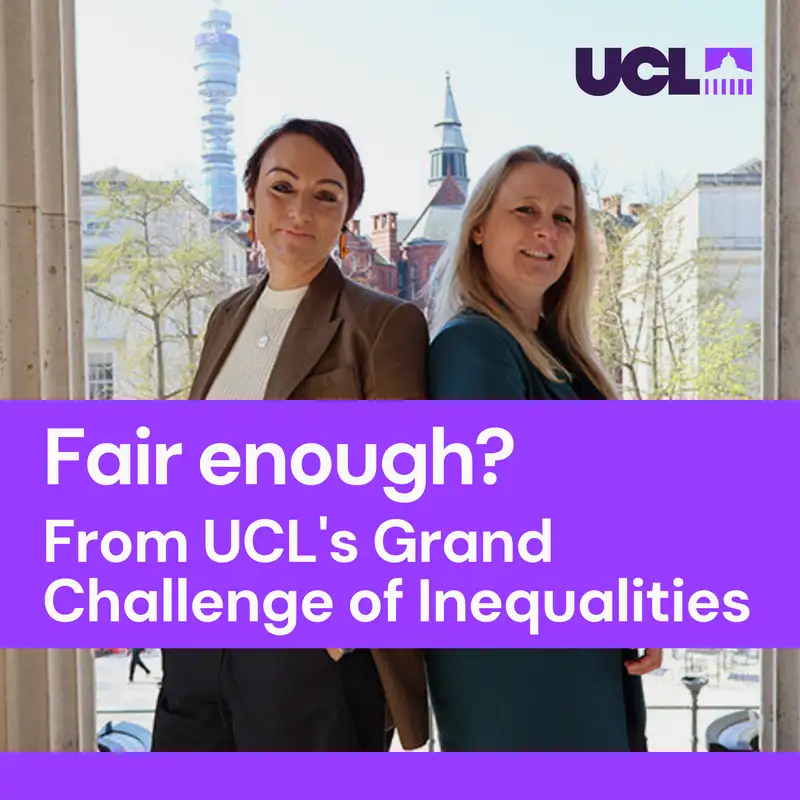
Lauren Andres: Hello and welcome to Fair Enough, the new podcast from UCL Grand Challenge of Inequalities. It explores existing and emerging innovative solutions for delivering everyday justice. I'm Lauren Andras.
Victoria Austin: And I'm Victoria Austin. In this series, we bring together visionary leaders from across disciplines and sectors to ask one simple when it comes to tackling inequalities, are we doing enough?
Lauren Andres: Whether you work in industry, government policy or research, or you simply care about what a fairer future could look like, this podcast is for you. Let's get started. In today's episode, we're going to be exploring inequalities from a spatial perspective, looking specifically at cities and urban development. We're joined by two brilliant guests. Welcome. Bridget Wilkins. Bridget is head of Adoption, Engagement and Innovation at the Ministry for Housing, Communities and Local Government. Bridget's passion lies in how to bridge the gap between people, policy and technology to revolutionise the planning system and built environment. In her current role, she's focused on how to accelerate the adoption of a modern planning system, including the scaling of the Proptech Innovation Fund, the largest UK government government investment into the sector to date. Bridget is also the chair of Footwork, a network of contributors united in the belief that supporting community led regeneration builds resilient places and leads to positive, lasting social change. We're also delighted to be joined by Mike Raco who is professor of Urban Governance and Development in the Bartlett School of Planning. Mike is also the Head of school here at University Golledge London. Mike has worked extensively on approaches to urban regeneration in global cities. He has also contributed to debates over the governance of mega events and contract led forms of project delivery. His most recent book is entitled London with Francis Brill and is part of a Megacity series published by Agenda Press. He's currently working with me on a project examining the impact of AI technologies on planning systems in the UK and China. Welcome again to you both. We're delighted to have you.
Bridget Wilkins: Thanks Lauren. It's great to be here. Really excited for our conversation.
Mike Raco: Thank you. Thank you, Lauren. Looking forward to it.
Lauren Andres: Okay, so let's get to it. My first main question is really when we're looking at the elements of spatial inequality, what is, what do you feel are the most pressing and the most problematic issues at the current time, especially with your key roles in the urban development urban planning process. Mike, do you want to have a go here?
Mike Raco: Well, thank you, Lauren. so what elements of spatial inequality feel most pressing? It seems to me that there are two key things. One is around housing, it's around access to housing. It's around fairness in terms of the distribution of housing and it's also about the ownership of housing assets. And we're going to come back to some of these, I'm sure, later in the discussion. The second issue is around access to decision making and local control and, the ability that individuals, citizens and communities have to take control of the wider processes and agendas that are affecting them. And one of the biggest problems we've seen in a country like Britain is that the ability of those groups to exercise local control has become more and more strained over time and more and more distant. So that second issue is really about the ability to control things and the ability to control the things that influence your lives.
Lauren Andres: Yeah, absolutely. And I'm sure, Bridget, that resonates with what you're seeing in your everyday job.
Bridget Wilkins: Absolutely. And I think to build on that, you know, we clearly have a chronic undersupply of housing and related infrastructure across the country. and we've seen the consequences of that, being undersupplied and the ripple effects that leads into other sectors such as healthcare, education, social mobility, opportunity. and so it's really interesting to look at what role housing and its related infrastructure has to play to not just respond to the inequalities we're seeing in the built environment, but how it can support other sectors and areas of, our social and cultural economies as well. I mean, in London last year there was, you know, just over 5,000 units delivered and we know that requirement, was closer to 88,000. So there's a
00:05:00
Bridget Wilkins: clear gap there. In London alone, we see that kind of relationship perpetuated across the country in terms of housing delivery. And I think what's also interesting is this related piece around the infrastructure, particularly from a social infrastructure point of view. What are the areas of the built environment that help us feel connected to place and connected to each other with and around the housing that we so chronically are trying to deliver, through our government agenda, and I think to build on what Mike's saying, what I'm quite curious in is how we enable those two areas to come forward at a level of scale and speed through revolutionising the planning process and the planning system. Particularly looking at how we can make better informed, data led decisions and where those decisions are made and by who and how we might bring communities and other stakeholders into that process. I think it's going to get really interesting, in the months to come.
Lauren Andres: And I mean we know that access to housing is crucial and we know that Housing is everything, for many people. And I mean it's very much at the core of inequalities. And I mean for us as well. And I think I'm saying us as us within the sort of the field of, of the built environment. I think when we're thinking housing, we're thinking places and we're very much thinking about the delivery of good and equal places, because it's not only places, but it's people. And it's very much this relation between how really to ensure that we are fair for everyone and we creating good places and we tackling the inequalities.
Victoria Austin: I'm actually really interested in what you both said, though it raises for me quite an important point because the ownership of housing is about economic inequality and the decision making is about political inequality and they affect different demographic groups inequally, which is about cultural inequality. So you kind of put the pin in exactly the space that we're interested in working in. Mike and Bridget, you illustrated that so well in the case of London. And it's interesting to take London as a case study, I think, because it's such a, dynamic city with broad actually mayoral commitments around inequality, but yet still it's hard to deliver. So, I mean, maybe thinking about London first and then more broadly, what opportunities do you see for addressing this over the next five years, given the rate of challenge that we have before us?
Mike Raco: Yeah, that's a very good question. I mean, perhaps just back to a couple of things really. I mean the. It hasn't always been like this, in London. So if you go back to the early 2000s, planning agendas were all about building good places, were all about building what were called sustainable communities that would be mixed, that would be balanced was the term that was used. They would be designed to cater for people at different life stages. They would have economic infrastructure, but also back to what Bridget was talking about earlier, they would have social infrastructure to support people at different points in their lives. And that was what the planning system set out to deliver and achieve, really from the late 1990s up until about 2010. The problem in London is that since then there's been a drive towards what we call the financialisation of housing, or housing becoming an investment asset as well as a home as well as a place to live for people. A big part of the problem with that is that planning has been about trying to encourage investment, to put housing on a pedestal, to see it as something that you can make money from, to see it as something maybe that can Also enrich individuals who own it, rather than seeing it as a foundation of what it is that makes a sustainable or good community or place. And it's that that's fractured some of the relationships between the delivery of housing, the making of homes and what it is that places have become in London. And in London it's specifically difficult, because at the same time it's also a global centre. It's the centre of the international finance pouring in to the built environment, a lot of it going into housing. And so you've got this set of initiatives happening which mean that we see a lot of development in the city, but that development is not of the city or not of the places in which people live. And so one of the big challenges that planners have faced here is to try to link development projects to good place building. But it is incredibly challenging because one of the other things that's happened is that I mentioned the loss of local control. It's also linked to the fact that local government in London and also across England are ah, struggling with enormous, cuts to their budgets. They are struggling with indebtedness. They don't have the powers, resources and levers to bring about the building of good places. And so you've got
00:10:00
Mike Raco: a whole cluster of. Some people have called it a poly crisis of different things going on, which reaches quite an extreme level in London. And I go back to Bridget's point earlier, the lack of construction. We are 94% below the target of housing delivery in London for new homes. And we are going to have to start thinking quite a lot about how we might remake the existing housing stock we have, how we might start to maybe redistribute some of that, but also how we might convert the planning system into something that generates more abundance of these key things that we need, particularly around housing and social infrastructure, rather than in some places being seen as a barrier.
Victoria Austin: That's really helpful, Mike. And I guess you know, this is a pattern that we see in London, this idea of the use of housing as an asset rather than a home. The idea that we can't prioritise place making but rather have to weigh the financial burdens that local authorities and others are forced to contend with. Is this a picture, Bridget, that we also see nationally?
Bridget Wilkins: It's a great point, Victoria. I think it speaks to a few, elements across the system. And one is the fact that, you know, we have quite a fractured and fragmented housing system. And we all, probably different stakeholders have different definitions of housing, of infrastructure, of delivery, of Viability. We've so, et cetera, work. and I think it's been well recognised that, there is a lack of capacity to deliver housing across the country at speed and at scale, particularly in places that, have an acute need for that housing to be delivered. And clearly, that is a clear priority for our government. We have a very clear mandate to deliver 1.5 million homes in this term of Parliament. And there's been an amazing amount of work done, from a policy and a funding point of view through our department, and through Holmes England and other councils to try and respond to some of those challenges. But I think there's still some fundamental principles that go beyond the realm and levers of government and that really speaks to the challenge around viability. So how do we ensure that these, These, housing renewable structure projects can financially stack up? They're feasible and they're still attractive enough as an investment proposition for developers, whether private or social, that encourages capital to come into the UK and invest and deliver, but still has enough kind of scope in that viability to provide the other areas of social infrastructure, and other community uses as well that I think perhaps you were alluding to there. I think that dance between the viability for different users from an investment point of view is something that, we have to keep considering in looking at where and how different models of housing can be delivered. And, there's been some interesting kind of initiatives. The City Hall Developer Investment Fund, which was put out through the Mayor of London. You know, it's a really interesting model to say, what would different types of investment look like to respond to some of those investment gaps? Could that help from a viability point of view? And could that help particularly drive forward the provision of social and affordable housing? And I think it's also going to encourage some really interesting models of collaboration and coordination across the sector to try and respond to that in London, but perhaps it'll be a blueprint for other parts of the country as well.
Lauren Andres: I think on this, I think, Bridget, you're involved in the New Town programme. and I'm just wondering if you see actually the New Town as an opportunity to try to address those case issues.
Bridget Wilkins: Of course. I mean, Newtown is an incredible part of the government's agenda as part of their ambitions. 1.5 million homes. There has been an industry task force that was assembled around this. There has been a report that was published in September last year that kind of set up the mandate and the ambition for how new towns could be delivered and the level of scale there I think is perhaps a once in a generation opportunity for us to really think about how and where these pockets of sustainable growth could happen and manifest across the country. Building on existing infrastructure, existing place and building with rather than against, and perhaps also catalysing some new areas that haven't had the viability or the funding opportunity to bring in infrastructure. But with the support of new towns as a, as a government programme, could that help capitalise and incentivise, more investment into areas and would that actually help bring these places forward on a more effective and efficient basis which would ultimately make it more financially viable for developers, and local authorities and other partners and we would hope then translate to wider social outcomes as well, which I'm assuming is part of this discussion today. So we think there's a huge opportunity for new towns to respond to that.
Lauren Andres: M and listening to you both, I'm just wondering as well, in terms of opportunities, I mean, do you think where we stand now, because fair enough, we are in a poly crisis moment at the same time, often it's within crisis that amazing opportunities arise. And I'm just wondering in regard to this, I mean, do you think there's scope to rethink our current urban development models? Is there scope to do things differently, to do planning urban development differently in order really to embrace those opportunities and try really to tackle those key issues including housing provision?
Mike Raco: Yeah, I mean it's a very good question.
00:15:00
Mike Raco: I mean there's a short answer and a longer answer. I mean the short answer is that you, you could go back to look at what used to work, and what we could take from past experience that could be helpful. So that's two things. Under the sustainable communities legislation of the past, local authorities had what was called a power of well being. They could use the planning system in their local areas to promote developments and promote projects that overrode many other aspects of the planning system in if it could be judged that it was in the well being of local people for them to do that. And this legislation came in under the Labour government, the Blair government, it was then abolished. But it seemed to me that was one type of initiative one could take where if you could imagine empowering local government through resources, through devolved power, giving local authorities the power of local well being to decide what it is that local community groups, citizens, businesses and other interests need. There's a real potential there to use the system to be much less about trying to think about market viability and a bit more about building what we might call social infrastructures and thinking about what some people have called the foundations of good places. So part of it is about that side of things. The other side though, does come back to pounds, shilling and, pence. It does come back to questions, as Bridget says, of viability. The issue here is that if you have a model in which the housing is going to be constructed by market actors who need to generate sufficient returns to also then provide, they're asked then to provide some social infrastructure, some affordable housing, all kinds of other things, if you're going to have a model like that. The problem is that those actors are facing incredibly difficult challenges. The costs of construction have gone up. There are not enough skilled workers. It's very difficult to find the right sites for new developments. There are new planning regulations that impact on the cost of development. So give you an example, after the Grenfell fire, there's a whole lot of new regulations that people building houses need to meet, quite rightly to create better places. But that creates cost. And if it creates cost because the standards are higher at the moment in the current system we have, it simply means that those projects are less viable and there's less resource to pay for other types of social infrastructure. So one answer I think is to really rethink what the relationship is between what states do and what they pay for. Whether it's around gap financing, old fashioned things like that, whether it's about training of skilled workers to work in the construction sector, whether it's about subsidising costs of energy or subsidising costs of materials. There's a role for the state, but clearly within this. But they're also a key role for market experts to do what they go and do best. And it seems to me that that relationship needs to be rethought structurally in the English context and the London context, because at the moment, to be generous to some of those developers and investors, they're being asked to carry an awful lot of the burden of what the planning system should be delivering in terms of fair, equitable and good places. And that's a big ask in an environment where it's increasingly difficult to generate enough return.
Victoria Austin: I think that's a really good point and actually it's not one that's been in common parlance. I think we've often seen arguments to reduce those broadly social commitments, whether that's a reduction of the requirement to provide social infrastructure, which of course affects different communities in different ways, and poorer communities rely much more heavily on those social infrastructure. Elements than richer communities, or whether it's about reducing accessibility requirements or as you say, safety requirements. Quite often the argument's made in favour of making schemes viable, but I haven't heard so often this kind of notion of actually rethinking the relationship, the kind of tripartite relationship between the state, the developer and the and the owner of the space or the place or in fact the home. And do you have a sense of what that might look like? I mean Bridget, is that something that comes up a lot in your work for for the Ministry?
Bridget Wilkins: Yeah, it's a great question, Victoria. Definitely. it's something that we're observing through our Innovation Fund. So, you know, it's a different part of the problem but it, it's starting to uncover a similar outcome around how does bringing technology or a digital and data lens, enable a new type of conversation around delivery to occur between local authorities and other stakeholders, you know, groups like statutory consultees, the Planning Inspectorate, arm's length bodies, sometimes where there has been perceived to be perhaps a more adversarial nature based on kind of how people can
00:20:00
Bridget Wilkins: and can't engage through the planning system, but actually by bringing people together over a shared common interest or curiosity or ambition around digital transformation, around AI capacity building, you can have a different type of conversation and you can start to build different types of relations and relational work, which we're seeing kind of through our Innovation Fund, which I can talk about in more detail. The other area that I'm seeing this through our work at Footwork, which is a community led regeneration, movement, and network that we're building and we've recently launched a programme with Camden Council and a number of people working in the community to bring forward underutilised assets that are owned by Camden. And where Camden is saying, hey, we want to repurpose these with and for the community, and the community have a role to play and we think that's a really interesting model to perhaps be scaled across other local authority areas and particularly at the point at where it hits other assets that aren't just owned by local government but also the development sector as well in terms of how do you bring forward those sites and areas, whether it's a garage or a bit of underutilised land by Network Rail as an example, and how do you fund it and at what point could the provision and the regeneration of those areas, which could become quite powerful, for local community groups, be funded by existing system interventions? Kind of your point Marc, whether it's section 106 or other kind of planning conditions and charges developers pay, or actually, are there new models that we should be investigating and exploring to look at how we could raise capital if it's linked to generating more sustainable and equitable outcomes through the built environment? Now, I'm not going to sit here and pretend we have all the answers, but it's a really interesting space because it's, it's very localised, it's contextualised, it's place based, it's with community and it's local government. And it's all about to your question, Victoria, changing those relations and looking at different roles, different stakeholders can play to try and respond to some of those opportunities. So I'm really excited to see where it goes next.
Victoria Austin: Maybe we can dive into the technology part in a minute. But just before I wanted to press a little bit on this new financial model or this new economic model, because I guess my real question is, are we brave enough, like, are we willing to accept that the, the relationship between the state and, the ownership of housing needs to change? I mean, it's quite a big political hot potato, really. Do you think, do you think that there's a genuine interest in exploring that, in a radical way, Mike?
Mike Raco: No, that's a very good point, Vicky. I mean that you could argue, of course, that the original projects that, that government led on privatising public housing was also extremely radical and daring and something people struggle to imagine would be, you know, a good solution to a problem at that time. And so it does need some political courage. I'll give you an example. I mean, the, the big, one of the big hot potatoes around property is how it's taxed and how assets are taxed and how land is taxed. I'm living in a house here in southeast London where the, as far as I'm aware, the property banding hasn't changed since 1991. And the level of council tax that I pay hasn't really changed very much since then. And you have the most regressive form of property taxation in this country that one could probably imagine, really. And so that will take a lot of political courage to start to link the relationship between asset ownership, your financial, portfolio, if you like, and what you own in your life and what you pay in tax, rather than linking your taxation primarily to your income. Because for a lot of people, their key source of income now is actually through their asset ownership, with the asset ownership inflating during their time while they've Been earning money, but it actually. So one way of, of thinking about this a bit more progressively to think about that, it does generate enormous, difficulties. M When you try to tax farmers the value of their land, you realise that it's a virtual asset which would require the sale of the land in order to raise the money to pay the tax. So you do have enormous structural difficulties. And you have the other difficulty, which is that as foundational economies and places are fragmented, as welfare systems have become much more patchy, people look to their assets to provide for their welfare longer term. What some people have called. Like, Colin, Crouch has called privatised Keynesianism, the idea that you look after yourself.
Victoria Austin: Isn't that an oxymoron?
Mike Raco: That is a complete oxymoron, isn't it? The greatest of oxymorons? But it's a privatised form of welfare because you need your asset to look after you in older age, because the state provision in older age, you don't think is of a good standard for yourself. And that generates all sorts of inequalities, of course, moving forward. So yes, it does require some very structural, very difficult political changes. Perhaps one way to think about it, so for bridge it in here, but there's a lot of writing about
00:25:00
Mike Raco: what's called a system of provision around housing, which is about the land, the skills, the materials, the energy costs, the planning system, the regulations, the markets. Trying to think about housing provision as something which is systemic and something that develops over time, evolves. And you really need that kind of thinking in order to start thinking about the house building process. What is the existing structural system of provision that you have at, ah, what stages do we need to redirect that system of provision and with what kinds of outcomes in mind? And that does take a lot of political courage and political thinking. Just one final thing, Vicky as well, the amount of money the state spends on housing benefits to pay people to be in private housing, rented housing, instead of what used to be state housing, is absolutely enormous. I mean, I can look up the current figure afterwards and add it in, but last time I looked it was about £24 billion a year or more being put into the private sector to do what it is that the public sector could do at a fraction of the cost and I dare say higher quality. And so it just needs some political resetting, rethinking and a bit of political courage.
Lauren Andres: This goes back to the issue of, the provision of housing and how little, we built and how, as a Result, the planning system is at the forefront of trying to find solutions and do things differently. And here I would like to come back to Bridget here because obviously AI here is playing a key role. The planning sector is at the forefront of trying really to input AI technology in the delivery of the planning system, to try to tackle all those issues around regulation, compliance, bureaucracy and all those criticism that we hear, especially from the national government, around the fact that the planning system is broken, is not delivering enough housing. And I know Bridget, you've been involved into really looking into those key issues and there's a lot of various initiatives, scoping, projects going on in London and outside of London and I'm just wondering if you could tell us about it.
Bridget Wilkins: Of course, I'd love to and I promise I'll try and be, succeed because there's lots going on and it's a really, you know, like anything Mike, the challenge creates the opportunity. Right. And because I think many of us have acknowledged the system is broken, it's been underinvested in as a lack of capacity, as a lack of bandwidth, depending, on kind of how you're looking at the system, there are clearly opportunities that are right for digital disruption, and the use of technology. And inherently, AI is part of that to improve efficiency, transparency and trust. And it shouldn't all be about those three pillars. It's also that people and humans and our experience and how we turn up as planners and as built in bioprofessionals and as people working across different parts of the system but still linked to planning as well and as citizens trying to access and rely on housing as part of our own kind of foundation, as you say, for wider growth and inclusion. But yeah, coming back to your question Lauren, we see a huge opportunity for the role of technology to try and respond to some of those challenges and opportunities, particularly in how it can do two things. How it can help fast track decision making process through the planning system, and how it can help increase local government capacity. Because we know that is a key opportunity to actually boost the performance of the whole system because no matter who the developer is, it has to go through the same process at a local authority level. So how do we automate that, how do we optimise that? And that for me is really thinking about where at those points of planning can we optimise speed and scale through technology. So our digital planning programme has worked, hand in hand with local government and over 100 councils through our open digital planning network. It was a community approach we seed funded over five years ago and built it up now to have co designed a number of digital products that help automate the planning decision process for development management. Planning applications might not be the most revolutionary area of planning, but it's actually a huge bottleneck for efficiency and performance. And we know that, you know, of the 400,000 of the 350,000, depending on what you're looking at, number of planning applications, over half those planning applications that are submitted are invalid the day they are submitted. So you've got 50% failure rate in the system from day one. And so there's a huge opportunity there for technology to reduce that failure rate, and to boost productivity and actually help local authority get growth planning applications as fast as possible. And on the other side we have a ProperTech innovation fund which is kind of the space where we go, okay, what else is out there that we could support, catalyse, steer and fund seed, seed fund into, that can do the spaces and areas beyond just reviewing planning applications. And that fund was established about four and a half years ago. Initially it focused on digital citizen engagement and the consultation process
00:30:00
Bridget Wilkins: because we know that's both a blocker to getting local plans and sites and development schemes delivered. And we know that the current process doesn't really work for anyone involved. Citizens haven't really got, modern methods like tools to engage councils, and councils often are, kind of stuck in very analogue methods. So, you know, we work with about 70 local authorities to trial and adopt a range of digital tools in that space and understand what can work at a national and local level. How can we use gamification surveys, instant polling, social media, digital channels and AI, to analyse the feedback to optimise that consultation piece of the planning puzzle. And then more recently in the last 18 months we've said, okay, well how do we bring this incredible property technology prop tech sector, that's focused on land and viability into local government. And our more recent rounds of funding have focused on unlocking land viability, site assessment and ultimately housing delivery. and I would encourage everyone to look at kind of our applications and our case studies online because we've got a number of examples there where councils were running their land assessments, you know, in Excel spreadsheets or on PDF stuck to the wall, because that's the system they had to work in. And we've been able to work with them to say, hey, if you could use this piece of technology, how could you deliver faster? Where are the gains to be made? How does that Free up your time to have more strategic thinking and conversations. And the case studies speak for themselves. You know, we've seen 98% reduction in planning officer time using AI to review consultation responses. A human is still in the loop, a human still makes a decision. The AI is just doing that first pass of analysis. So it doesn't take six months for a plan to do it. And we've seen it in land and site assessment made by councils using more, you know, data led decision, tools around sites and data and kind of geographical information to inform that decision making process. They're finding sites faster, they're finding them more effectively and they're finding more sites. So they're actually increasing the density provision of housing allocations for local plans by using technology. And I think it get really interesting in that space. I could talk about it all day. So I'll stop there and kind of open if you have any more questions you want to dig into. But we think there's a huge opportunity there, for local government to capitalise on about the 300 or so different technology solutions that are in the space and our role is to continue to bridge that gap.
Victoria Austin: Nice. You know, you make a really good point in terms of the reduction of time and the increase in efficiency. And notwithstanding that AI still contains bias, we're working towards a situation where some of those solutions will really unlock, homes for people and that's important. I wonder if there's also something more aligned to community. Just go back to Mike's point at the beginning. Community ownership and sort of community asset ownership or the community land trust model. I mean, do we think that there's an opportunity to think a bit more about this?
Mike Raco: It's a very good point you make. I mean, of course the danger of the discussion around the kind of automation of planning in this way is that it maybe opens up some questions about the relationship between AI and what the planning system is. So is AI there to serve the needs of the existing planning system, to automate it, to allow innovation within it to do what some people have called augment the existing system, make it work better? The danger of course is though that you might start to say, well, the AI technologies are actually much better suited to very simplified readings of places, to what developers need, that maybe you start to think about how you use AI as a tail to wag planning as a dog. In other words, you start to say if you could change the planning system and make it more amenable to some of the best forms of AI, you'll get even better outcomes. And then the danger, of course of that might be that you start to think about the planning system principally as a delivery focused mechanism, which partly is, of course, but the danger is that how do you build some of those levers of community engagement, levers of community influence, the traditions of discretionary planning that have always been about negotiation. How do you build those kinds of values into a system where AI may have a tendency to codify things, to put things into numbers, to turn them into development spaces, if you like? that's a real challenge people like Brigid are really, really working on at the moment. and it's not an easy one, to address. perhaps the final point is that the other danger, of course, in all of these discussions is that there is a danger that our understanding of the good things about the existing planning system are actually eliminated by AI rather than augmented. So that rather than leading to more innovation. I like the point Bridget makes about humans still having a key role within this augmented planning. With AI, that's
00:35:00
Mike Raco: really important. But there's a danger of course, moving forward the resource staff, local authorities, begin to eliminate that, begin to eliminate that professional role. and what might that mean going forward? It's clearly something that is a huge issue then, in terms of control, ownership and who at which level was controlling those processes. I've had planners say to me that you'd solve the English planning systems problems around the things we've been discussing by standardising all forms of community engagement, by standardising across the country, all types of, deliberation, digitalizing it, and then you'll get outcomes. But the planning system is built on local deliberations that are supposed to be different and diverse. So how does one manage that tension is a really, I think, a really exciting area though for us going forward. There's a lot insurmountable problems. I think the real opportunities to be innovative, and to work, out some exciting, ways in which you can balance space and place, the needs of development spaces and the needs of good place making.
Bridget Wilkins: I think you raise kind of one of the big questions for us as a system, right in the uk, we know planning is an enabler, one of many, for housing delivery, which hopefully will help respond to some wider inequalities and tackling those. but how does it shift and where does it move? And which parts of that planning system can become centralised and standardised and which parts can still be contextualised in a local basis so that people have scope to inform and shape their places. And there are the right planning mechanisms for that feedback and engagement to inform how those places are shaped. One of the things we come up with is exactly your point around. There are some clear risks with AI and automating a process. And the flip side is though, right now, the unintended consequence of not having that though, is that every single council in this country makes decisions slightly differently. There is not one consistent way to do it and we all work in different planning hierarchies and different policy hierarchies, but it's all quite nuanced, it's all quite subjective. And now that works if it's capturing the feedback in a local, democratic sense through the consultation process, but if it's not, it's just getting more complicated and slowing down a process. So I think one of the big questions, one of the big downces we have to do is in this, as we look at the role of automation and augmented decision making, where are those opportunities where standardisation of those decisions would create enough consistency for productivity and efficiency and highly of enough scope, perhaps in some areas of local plans or strategic planning, where actually there is, it can still be contextual. I think that's one of the big questions that hopefully we can answer between us collectively as a sector. You know, in the years to come, with the conditions that we have now with the NPPF and the planning infrastructure bill and the mentor around digital and the focus on communities, it feels like we have all the ingredients to be able to answer that with a few more collective viewpoints and, I'm really excited to see where it goes.
Victoria Austin: That all sounds quite exciting. And actually, I mean, I spent almost ten years working on the regeneration of East London pre and post, London 2012. So I was actually responsible for a lot of that community engagement with disabled, people and communities interested in accessibility. And it was important, I guess for me, especially thinking about the Pride in Place agenda. This deliberation also provides a function of enabling communities or elements of communities, because of course not everyone engages in this process to have thoughts about what type of place they want to live in and, or make. And I think it's important that as we design these new systems and the automation process, we don't lose that. It's a bit similar to the point about systems of provision, counting not just the costs but also the value that is generated through the system. And I think it's important that we kind of allow both sides of that argument to be present as we move forward with solutions, which is, you Know, we've talked about quite a lot of solutions today and I think now's probably a good time for us to wonder what your view is on how and whether, UCL's grand challenge should be focused on any elements of this. And if we were able to invest in an element of, this area of focus, what would you suggest that should be?
Mike Raco: Should I start, Bridget?
Lauren Andres: I can see Bridget's facing. Whoa, Mike.
Mike Raco: I mean, just thinking about what you're saying, Vicky. understanding how AI is being used by different interests and groups, understanding the types of digital divides and, barriers and drivers of the use of AI, by different groups. And, There's a lot of writing, as we know, about things like biases and so on, which. Which are clearly very prevalent. But it's also about that there's a. There's also understanding how this new technology is impacting on those existing types of inequality and where these technologies maybe provide bridges for overcoming some of those barriers.
00:40:00
Mike Raco: So I'll give you an example. One of the things that I've been talking to students about for the last 20 years on planning courses is the difficulty in objecting to planning applications for community groups. And a lot of community groups for decades have gone to very, generous lawyers who give them often pro bono work and free time. But quite often instead of going to a politician, you'd go to a lawyer in order to try to get a development stopped or to change it. Because the planning system was so technocratic. Suddenly there are AI tools online where for £45 you can buy an AI written objection built on the things that you think are important so you can input into it. It then puts them into a technical format for you. And, you could argue, some people would argue this is a democratisation of the planning system. Suddenly the knowledge has been distributed, it's been spread. On the other hand, you might, Still within that, you might see if you do some proper research, that there will be new inequalities emerging, new types of use, new types of ownership of that process. But it seems to me to be an urgent agenda there about how we democratise the AI systems we have, but in a way that doesn't allow certain interests to capture those forms of democratisation in ways that become very sectional.
Bridget Wilkins: Great.
Victoria Austin: I guess that talks to how we measure success not just in terms of number of units, but in terms of good places.
Bridget Wilkins: I think there's a really interesting moment in time that we're kind of looking ahead to, particularly for where you're looking to take this Work, and I think most of us here today and across the sector recognise, ah, the why of this work and the what that needs to be done. But we haven't yet got clarity, it seems, on the who and the how. So who across the system is going to fix this and with what levers? And the automatic response is government. Okay, but who in government, who in local government, who in the private sector, who in academia? And I think the thing that's still missing from my perspective is I don't want to say roadmap, I'm just going to say map. Like how do we get from here to where we need to get to when it comes to the provision of more equitable spaces, housing and social infrastructure that respond to, you know, the focus of your work? And what role do we all have play in that, in weaving together existing and new systems for delivery that recognise the opportunities and constraints, to your point, Mike, between digital, physical and social infrastructure. And to me that's still a pretty unanswered question, and it's right for answering it in a way that doesn't just help us as a sector have a map of who could do what to take this agenda and this mission and this work forward, but also how we position this work so it breaks the echo chamber of the built environment and we make this issue an issue that is seen to be a national issue because housing affects us all, and infrastructure affects us all. And if there's a way for this work to respond to that and kind of get it more in the national discourse of saying, hey, actually this is a fundamental human right and it hasn't happened. So let's think about what that could look like, how it could be valued, how it could be perceived. I'm not trying to say we do all of that, but for me that's a real opportunity. And perhaps you want to respond to some of that through this work. because by doing that we'll bring more interesting viewpoints in, we'll bring more diversity in and divergent viewpoints, we'll bring more ideas and we'll challenge the status quo. It'll challenge some thinking. It might also help us think about new ways of delivering. And I think that's been a consistent theme of this discussion. So excited for how a, map could help us weave together who's in the system and who's outside the system and how together that might put a path forward.
Victoria Austin: All of which needs to fit within a brave, political, courageous framework for change. Right?
Lauren Andres: That's a big yes thank you both. It's been absolutely fascinating, exciting discussion and really a lot of foo foo faut for us to work now, to work with all of you here and also just really to bring, some new insights into those debates about inequalities and how we can create very much a much fairer world. Before we let you go, we always end our podcast with one final question. And, this question is the following. If you had to leave listeners with one book, one artwork or film or song that captures the ethos of fair enough, what would it be and why? Bridget do you want to go first?
Bridget Wilkins: I took a slightly broader angle to answer this because this book, I'm showing here, really, I think, for me, has been a bit of a catalyst in thinking about how we think about the future, how we think about futures and think about our role in them. It's by Rob Hopkins, and it's called how to Fall in Love with the Future. And it invites us to travel ahead in time to a future system, to a future
00:45:00
Bridget Wilkins: place, and think about our experience with the place and how we might make that happen. And I brought this to this because I think often we talk about the challenges and the constraints and the limitations because there are many and we should acknowledge those and name them. But if we don't forget about the power of radical imagination and, like, positivity and, like, yeah, wow, what could we do actually? Like, what could happen? How could it make us feel? Who else could be part of this conversation? How might we live differently then? I think we lose some of that magic. So my, my, my pitch is this. How to fall in love with the future. Read it. Travel ahead in time, and think about how you then might bring that back to reality. We can make that happen.
Victoria Austin: Love.
Lauren Andres: Brilliant, Mike.
Mike Raco: Yeah, that's not easy to follow, I have to say. I mean, the, the, the, the book I, I, I love is this one by Vasily Grossman, which is Life and Fate, which is a wonderful novel about the ways in which human beings living through times of unimaginable change, chaos, difficulty, in some ways suffering, still manage to hold on to their values and still manage to bring out their own humanity. And it is an amazing book to just reflect on the relationship between big history, big understandings, big understandings of world changes, but what it literally means for human beings in places and how those human beings strive to keep their, values afloat. It's a wonderful book.
Victoria Austin: What an amazing selection from both of you. And today's really given me hope, I guess. Thinking about AI for community empowerment, figuring out the who and the how of making change, thinking about how we have systems of provision that reflect not just the costs but the benefits of housing. And also sort of thinking back to the fact that this is not entirely new. You know, the UK and its cities have done this before successfully, so that gives me hope for the future. Anyway, I imagine it will be possible. Thanks so much. You really have given us food for thought for what today would be. Fair enough.
Mike Raco: Thank you.
Lauren Andres: Thank you again.
Victoria Austin: You've been listening to Fair Enough, a podcast from UCL's Grand Challenge of Inequality. This episode was presented by me, Victoria Austin and Lauren Andras and produced and edited by Annabelle Buckland at Decibelle Creative. If you'd like to hear more thought provoking conversations, be sure to subscribe so you never miss an episode. To Explore more about UCL's grand challenge of Inequalities, including our latest news, events and research, just give Google UCL's grand challenge of Inequalities. Thanks for listening.
00:47:43
Creators and Guests