Horizontal Injustice: Understanding Economic and Political Disparities
Why do inequalities persist, even when opportunities appear to be expanding? How do factors such as gender, ethnicity, and geography shape our life chances? And can technology help create a fairer society, or risk deepening existing divides?
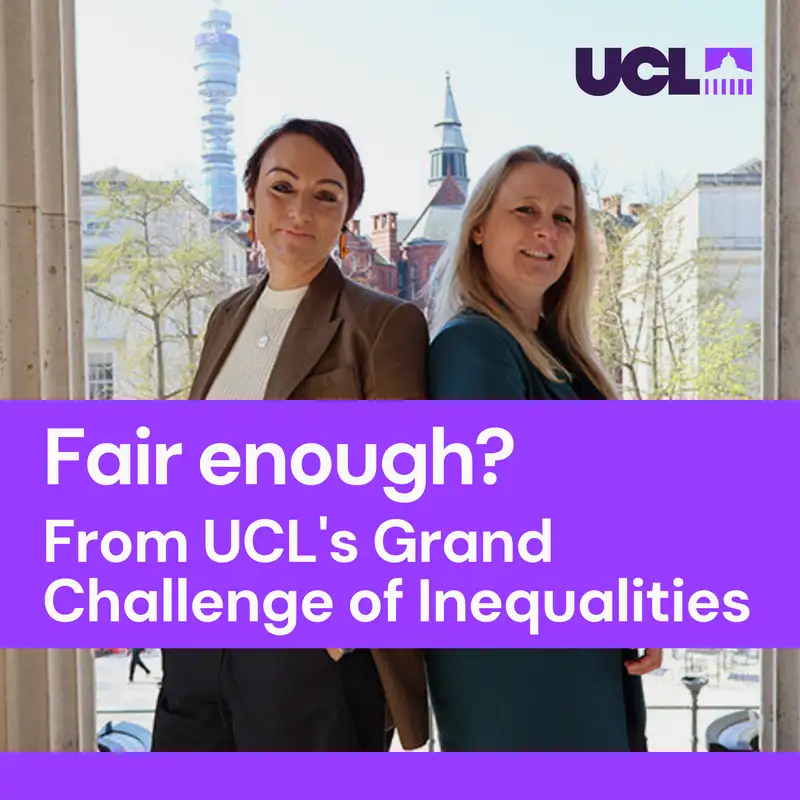
In this episode of Fair Enough, hosts Lauren Andres and Victoria Austin explore the concept of horizontal injustice: the inequalities experienced by different social groups that continue to influence economic outcomes, political participation, and social mobility.
They are joined by two leading experts: Professor Imran Rasul (UCL), an economist specialising in public policy and inequality, and Professor Peter John (King's College London), a renowned scholar of public policy and democratic engagement. Together, they examine why disparities persist across generations, the complex relationship between education and labour market success, and the growing challenges posed by wealth inequality.
The conversation also explores the role of technology, from artificial intelligence to behavioural interventions, and asks whether these innovations can help tackle injustice or inadvertently reinforce it.
Guests' Final Reflections
As always, our guests share a cultural recommendation that captures the spirit of Fair Enough: - Imran Rasul: Challenging Inequalities – the second volume of the Deaton Review of Inequalities. - Peter John: From the Gutter – a quartet from Benjamin Britten's opera Peter Grimes.
Fair Enough is a podcast from UCL's Grand Challenge of Inequalities, bringing together researchers, policymakers, and practitioners to explore ideas, evidence, and solutions for delivering everyday justice.
Produced by Decibelle Creative.
In this episode of Fair Enough, hosts Lauren Andres and Victoria Austin explore the concept of horizontal injustice: the inequalities experienced by different social groups that continue to influence economic outcomes, political participation, and social mobility.
They are joined by two leading experts: Professor Imran Rasul (UCL), an economist specialising in public policy and inequality, and Professor Peter John (King's College London), a renowned scholar of public policy and democratic engagement. Together, they examine why disparities persist across generations, the complex relationship between education and labour market success, and the growing challenges posed by wealth inequality.
The conversation also explores the role of technology, from artificial intelligence to behavioural interventions, and asks whether these innovations can help tackle injustice or inadvertently reinforce it.
Guests' Final Reflections
As always, our guests share a cultural recommendation that captures the spirit of Fair Enough: - Imran Rasul: Challenging Inequalities – the second volume of the Deaton Review of Inequalities. - Peter John: From the Gutter – a quartet from Benjamin Britten's opera Peter Grimes.
Fair Enough is a podcast from UCL's Grand Challenge of Inequalities, bringing together researchers, policymakers, and practitioners to explore ideas, evidence, and solutions for delivering everyday justice.
Produced by Decibelle Creative.
Creators and Guests

Host
Lauren Andres
Lauren Andres is Pro-Vice-Provost for Inequalities at UCL Grand Challenges. She is also Professor of Planning and Urban Transformations at The Bartlett School of Planning, UCL, where she serves as Director of Research. An interdisciplinary urban scholar, Lauren explores how cities adapt and transform in times of crisis, from pandemics to emerging technologies. Her work focuses on resilience, sustainability and social justice, with a particular emphasis on the experiences of vulnerable groups, including children and young people. Her recent research spans pandemic recovery, future crisis preparedness, and the growing role of artificial intelligence in urban governance, with projects across the UK, China, and globally.

Host
Victoria Austin
Victoria Austin is Pro-Vice-Provost for Inequalities at UCL Grand Challenges. She is also Associate Professor of Social Justice and Innovation at UCL Engineering and co-founder of the Global Disability Innovation Hub, a global organisation working across 40+ countries to drive disability innovation for a fairer world. She now serves as Strategic Director, having stepped down as founding CEO in 2024. Victoria’s research sits at the intersection of disability justice, technology and urban development, with a strong focus on participatory, real-world solutions. She teaches on UCL East’s Innovation for a Fairer World and co-leads a Master’s on global disability and technology.